
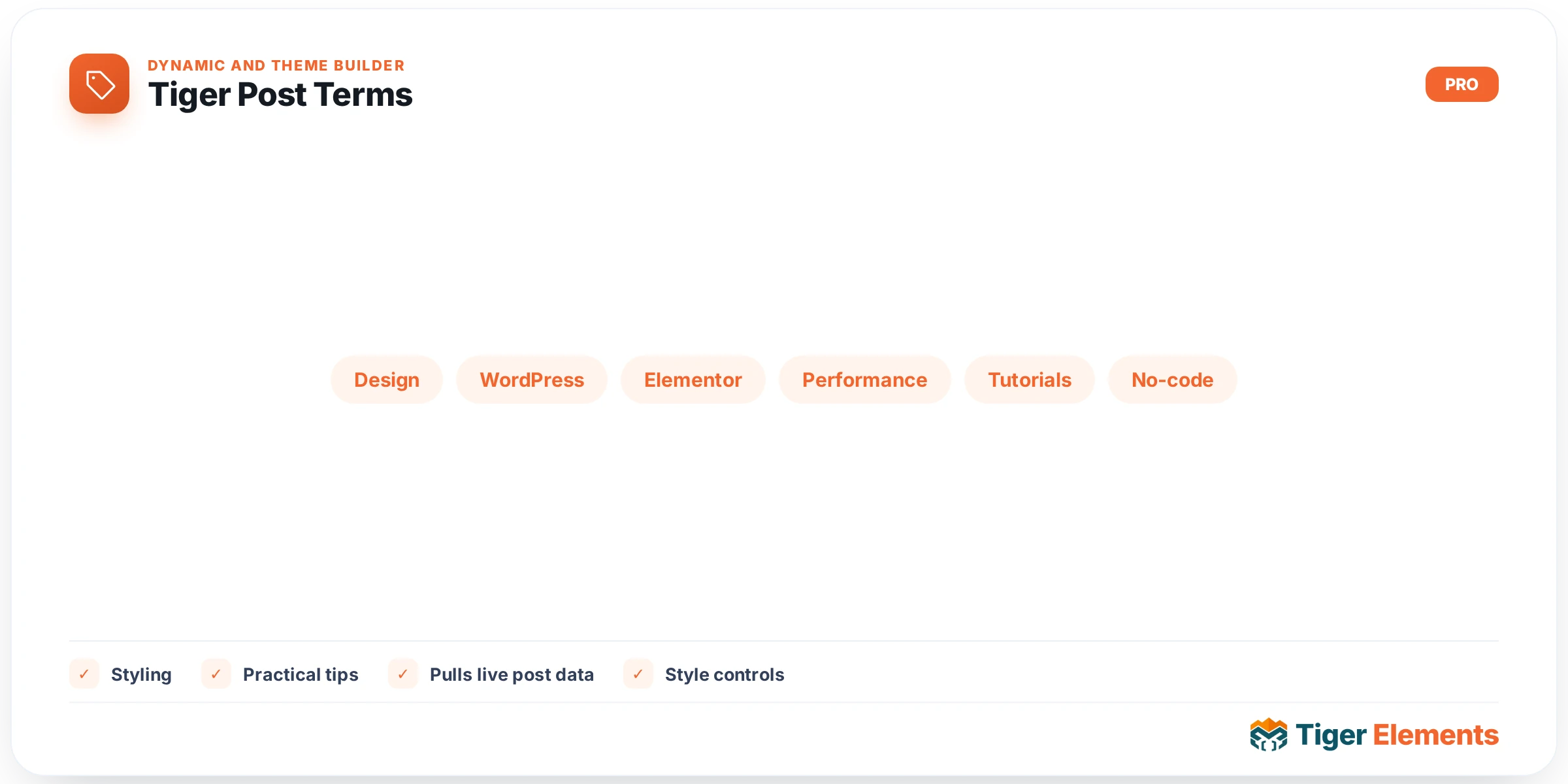
Tiger Post Terms is a dynamic taxonomy widget: it prints the categories, tags, or any other public taxonomy terms attached to the current post, and it is built specifically for single templates and loop items where the post is not known until render time. Rather than typing a static list of category names into a text widget, you drop this widget into a Theme Builder single-post template (or into a loop-item card) and it resolves the real terms of whatever post is being displayed — including inside Tiger’s own loop context, since the render logic checks the global $tiger_loop_post_id before falling back to get_the_ID(). That makes it safe to reuse the same template across an archive/loop grid without wiring each card manually.
Setting it up
Everything content-related lives in the Terms section. The Taxonomy control defaults to “Auto (first taxonomy)” — in that mode the widget calls get_post_taxonomies() on the current post and just uses whichever taxonomy comes back first, which for a normal post is usually category. If you want a specific taxonomy, e.g. a custom “Product Type” taxonomy on a WooCommerce-like CPT, pick it explicitly from the dropdown, which is populated from every registered public taxonomy (post_format is deliberately excluded since it’s rarely useful to display).
The Layout control switches between “Inline (separated)” and “Pills / Tags”. Inline mode joins the terms as plain text using whatever you type into Separator (default , , and it supports dynamic tags), rendered as its own .tg-terms-sep span so you can style the separator color independently of the term text. Pills mode drops the separator entirely and instead lays the terms out with flexbox gap, giving each term its own padded, bordered, background-colored “chip” — this is the mode to reach for when you want tag-style badges rather than a comma list.
Link to archive is on by default and wraps each term in an anchor to its term archive page via get_term_link(); turn it off if you just want plain, non-clickable labels. Fallback lets you supply text to show when the post has no terms in the selected taxonomy — useful for cards where an empty output would otherwise collapse the layout. Note that in the Elementor editor specifically, if a post genuinely has no terms and no fallback is set, the widget prints two placeholder terms (“Category A” / “Category B”) purely so you can see and style the pills while editing; that placeholder never appears on the live front end.
Below the separator you have real query controls that go beyond a typical “show terms” widget: Max Terms (0 means show all), Order By (Name, Post Count, Term ID, or “As Stored” to skip sorting entirely and preserve the natural term order), Order (Ascending/Descending, hidden when Order By is “As Stored”), Exclude Terms (a comma-separated list that accepts either slugs or numeric IDs in the same field, e.g. uncategorized, 12, news), and Show Post Count, which appends the term’s post count as “(N)” after its label.
Styling
Style controls are split so that pills-only options simply don’t show up in inline mode: alignment and gap live under Layout, while the Term section carries typography, padding, and border-radius (padding/radius only apply in pills mode since inline text doesn’t need a box). Normal/Hover tabs cover text color, background, and border color per term, and a Box Shadow group is available for pills. Post Count gets its own color and typography controls, and the Separator gets a dedicated color control — both only appear in the editor when the relevant mode/toggle is active, which keeps the panel from feeling cluttered with settings that wouldn’t do anything.
When to use this vs. a related widget
Tiger Dynamic Meta can also show a single term via its “Term / Category Name” or “Term Taxonomy Type” meta types, but it is built for showing exactly one primary term inline among other meta (date, author, comments) with a shared icon/label styling system — it has no concept of listing multiple terms, no separator, no exclude/order/limit controls, and no pills layout. Reach for Tiger Post Terms whenever you need to display more than one term, need pill/tag-style badges, need to filter out a specific category like “Uncategorized”, or need count/ordering control. Reach for Tiger Dynamic Meta when terms are just one item in a row of post metadata alongside date or author.
Practical tips
- If a post belongs to multiple taxonomies (e.g. both
categoryand a custom one), “Auto” is not reliable — it just takes whichever taxonomyget_post_taxonomies()returns first, which can vary by post type registration order. For anything but a plain post, set the Taxonomy explicitly. - Use Exclude Terms with the slug
uncategorizedto hide WordPress’s default fallback category from card grids without having to remember to categorize every post. - Set Order By to “As Stored” plus a primary-term plugin (or a taxonomy where you control save order) if you want the first-assigned term to visually lead — Name/Count/ID sorting will otherwise reshuffle it.
- In pills mode, the border, background, and box-shadow groups are wasted if Link to archive is off and you only need flat labels — switch to inline mode instead for a lighter DOM and simpler styling surface.